Do I Need a Garden Designer, or Can I Design My Garden Myself?

It’s one of the most common questions homeowners ask when planning a garden transformation:

“Do I really need a garden designer, or can I design it myself?”

The honest answer is that it depends on your project, budget, and goals.

Some gardens can be successfully planned by homeowners. Others benefit enormously from professional design expertise. Understanding the difference could save you thousands of pounds and help you achieve a much better result.

When Designing Your Own Garden Can Work

If you’re making small changes, such as refreshing planting beds, replacing a patio in the same location, or updating a few features, you may not need a professional design service.

Many homeowners have a clear vision and enjoy being involved in the creative process.

However, even seemingly simple projects can become more complex once issues such as drainage, levels, access, lighting, planting schemes, and material selection are considered.

When Professional Garden Design Makes Sense

Professional design becomes particularly valuable when:

  • You’re investing a significant budget.
  • The garden has challenging levels or drainage issues.
  • You want multiple features to work together cohesively.
  • You’re unsure how to maximise the space available.
  • You’re planning a complete garden transformation.
  • You want confidence before construction begins.

A designer doesn’t simply create drawings. They help you make informed decisions, avoid costly mistakes, and create a garden that works for the way you live.

The Hidden Cost of Skipping Design

Many homeowners believe they’re saving money by avoiding design fees.

In reality, the opposite is often true.

Without a clear plan, projects frequently encounter:

  • Changes during construction.
  • Materials being ordered incorrectly.
  • Features that don’t fit the space properly.
  • Planting that struggles to thrive.
  • Layouts that don’t function as intended.

These issues often cost far more than investing in professional design from the outset.

What Does a Garden Designer Actually Do?

A professional garden designer considers far more than appearance.

At Atlantes Landscapes, our design process looks at:

  • How you want to use your garden.
  • Sunlight and shade patterns.
  • Drainage and ground conditions.
  • Access and circulation.
  • Long-term maintenance requirements.
  • Planting design and seasonal interest.
  • Material selection and durability.
  • Budget considerations.

The result is a garden that looks beautiful while functioning effectively for years to come.


The Best Gardens Start With a Plan

Whether you choose to design your garden yourself or work with a professional, every successful project begins with a clear plan.

For larger investments, a professional design provides clarity, reduces risk, and helps ensure your budget delivers the maximum impact.

If you’re considering a garden transformation and aren’t sure whether professional design is right for you, we’d be happy to discuss your project and help you understand the options available.

A good design doesn’t just make your garden look better—it helps ensure every pound you invest works harder.


We work across Exeter and Devon, delivering carefully considered gardens that are built to last and easy to live with.

If you’d like to discuss your project, feel free to get in touch.

Tree Pruning in Devon: Best Time to Prune Trees and Professional Advice for Healthy Growth

When Is the Best Time to Prune Trees?

For most trees in the UK, late winter is generally the best time to carry out pruning. At this stage, the tree has shed its leaves, making it much easier to see its natural shape and structure. The tree is also dormant, meaning it is resting and under less physiological stress, so pruning is less disruptive. As temperatures rise in spring, the tree begins to grow again and naturally starts to seal and recover from the pruning cuts. That said, there are some exceptions depending on the species and the reason for pruning.

Trees That Flower in Spring

If your tree flowers early in the year, such as ornamental cherry, it is best to prune just after it finishes flowering. Otherwise, you may cut off next year’s blooms.

Can You Prune in Summer?

Light trimming to tidy shape or control growth can be done in summer.
However, heavy cutting during hot weather can stress the tree.

What About Autumn?

Early autumn is generally not ideal. Pruning can encourage new growth that may not cope well with winter frost.


How Much Should You Cut?

A simple rule is not to remove more than about a quarter of the tree’s canopy at one time.

Taking too much can:

  • Weaken the tree

  • Cause thin, weak regrowth

  • Increase vulnerability to disease

If someone suggests cutting a tree back dramatically just to make it smaller, it is worth getting a second opinion.


What Does Good Pruning Look Like?

Good pruning is careful and considered. It involves:

  • Removing dead or damaged branches

  • Improving shape while keeping the natural form

  • Making clean cuts in the correct position

  • Thinking ahead about how the tree will grow

Poor pruning — often referred to as topping — is when branches are cut back harshly without regard for structure. It may look tidy at first, but it usually leads to long-term problems.


When Should You Call a Professional?

You should seek professional advice if:

  • Branches overhang your roof, driveway, or pavement

  • There is visible deadwood

  • The tree is large or difficult to access

  • You are unsure how much to remove

Large trees near buildings or roads require proper equipment and experience to manage safely.


Why Pruning Matters

Tree pruning is not just about appearance. Done properly, it:

  • Keeps trees healthy

  • Reduces the risk of falling branches

  • Improves light and airflow

  • Helps trees live longer

Done poorly, it can shorten a tree’s life and lead to greater costs later.

If you are unsure whether your trees need attention, or would like professional advice on the best time to prune, our team at Atlantes Landscapes is here to help.

Contact us today to arrange a site visit or to discuss your tree care requirements. We would be pleased to provide clear guidance and a tailored quotation for your property.

Driveway Installation FAQs – Exeter & Devon

The following FAQs address key technical and regulatory considerations for driveway installation in Exeter and the wider Devon area. They cover planning permission, drainage compliance, construction standards, and material suitability, helping property owners understand what is required for a compliant, long-lasting driveway under local authority guidance. This information is intended to support informed decision-making prior to specification, design, and on-site assessment.

Do I need planning permission for a new driveway in Exeter?

In many cases, planning permission is not required, provided the driveway uses a permeable surface or directs surface water to a suitable drainage area within the property. Requirements can vary depending on location and property type, so we assess this during the site visit and advise accordingly.

Driveways Exeter Devon

What types of driveways do you install in Exeter and Devon?

We install a wide range of driveways, including block paving, permeable paving systems, and other hardwearing surfaces suitable for residential and commercial properties across Exeter, Crediton, Honiton, Exmouth, Sidmouth, Newton Abbot and beyond.

How long does driveway installation usually take?

Timescales depend on the size, ground conditions, and specification of the driveway. Most driveway installations are completed within an agreed timeframe following site preparation, with clear schedules set out before work begins.

Are your driveways suitable for heavy vehicles?

Yes. Each driveway is designed with vehicle loads in mind, whether for domestic use, multiple vehicles, or heavier traffic. Sub-base depth and construction methods are tailored to the intended use of the driveway.

Do you install SUDS-compliant and permeable driveways?

Yes. We design and install permeable and SUDS-compliant driveways where required, ensuring effective surface water management and compliance with current local authority guidance in Exeter and Devon.

Do you provide driveway installation quotes in Exeter?

Yes. We provide clear, site-specific quotations for driveway installation in Exeter and throughout Devon, based on a detailed assessment of your property and requirements.

If you are planning a new driveway installation in Exeter, Crediton, Honiton, Exmouth, Sidmouth, Newton Abbot and beyond, we recommend arranging a site visit to assess access, ground conditions, drainage requirements, and design options specific to your property. Our team is available to provide informed guidance and a clear, site-specific quotation, helping you move forward with confidence. Please contact us to discuss your driveway project or to schedule an initial consultation.

How Much Does It Cost to Build a Garden Deck in the UK?

If you’re thinking about building a deck in your garden, there’s a good chance you’re wondering:

“How much will it actually cost?”

It’s one of the most common questions we get at Atlantes Landscapes—and it’s a fair one. But the honest answer is: it depends. The final price of a deck can vary quite a bit depending on your garden, your needs, and the decisions you make along the way.

So instead of giving you a generic number (that may or may not apply to your project), we think it’s more helpful to walk you through the key factors that influence the cost of building a garden deck. That way, you can understand what drives the price up—or down—and make smarter decisions for your space and your budget.

1. Your Garden’s Topography: Is It Flat or Sloped?

Let’s start with the ground itself.

If your garden is flat and accessible, you’re in luck—that’s the most cost-effective base for a decking project. But if the area is on a slope, uneven, or has poor drainage, that’s going to increase the amount of groundwork needed.

Sometimes this means digging out earth, installing retaining structures, or even building a raised frame. It’s not a problem (we do this all the time), but it does affect the time, materials, and overall cost.

2. The Design: Simplicity vs Custom Features

This one’s big.

The more custom the design, the more time and skill it takes to build. A basic square or rectangular deck is always going to cost less than one with curves, levels, built-in seating, steps, or lighting.

But don’t let that scare you. If you’re planning to spend a lot of time out there—or you want the deck to be a true extension of your home—then investing in those custom features can really pay off in the long run.

3. Materials: What’s the Deck Made Of?

Your choice of material has one of the biggest impacts on cost—not just during installation, but over the life of your deck. So let’s walk through the main options we offer, including one we’re often asked about: Millboard.

Softwood Decking

Softwood (typically treated pine or spruce) is the most budget-friendly option. It’s easy to work with and looks great when freshly installed, but it requires regular staining and sealing to protect against moisture, rot, and fading. Over time, the ongoing maintenance can add up in cost and effort.

Hardwood Decking

Hardwood species like oak, ipe or aroko offer rich colour, beautiful grain, and excellent durability. It’s a higher-end option that ages well—but it’s more expensive upfront, and some types require oiling to maintain their finish. Still, for many homeowners, the natural beauty is well worth it.

Composite Decking

Composite decking is made from a mix of recycled wood fibres and plastic, offering low-maintenance performance with a natural wood look. It resists warping, cracking, and fading much better than timber—and you won’t need to sand, stain, or seal it each year.


Millboard Decking

Millboard is a premium composite decking material that deserves its own spotlight.

Unlike most composites, Millboard is not made with wood fibres at all. Instead, it’s crafted from a unique polyurethane resin blend reinforced with mineral fibres and finished with a durable, hand-moulded Lastane® surface layer.

Here’s why it matters:

  • Zero timber content means it won’t rot, splinter, or warp—even in wet conditions.
  • The surface is non-slip and highly UV-resistant, making it safe and long-lasting.
  • It’s moulded from real oak boards, so it captures the authentic grain and texture of natural wood—without the upkeep.

Millboard is ideal for high-end garden designs or coastal properties where weather resistance is critical. While it does come at a higher price point, many of our clients see it as an investment in beauty, durability, and peace of mind.

4. Site Access: Can We Actually Get In?

This is a surprisingly common issue. If your garden is easy to access with tools and materials, great. But if we’re navigating narrow passageways, steps, or restricted parking, it takes longer to get materials in—and waste out. That adds to the overall labour cost.

Also, if there are old patios, fences, or trees that need removing before we build, we’ll need to factor that in too.

5. Finishing Touches: Lights, Railings, Privacy Screens

These features are the cherry on top—but they do impact the budget.

Do you want LED lighting along the steps? A handrail for safety? A privacy screen for neighbours? These are all worth considering early in the planning process because they affect how we design the deck (and price the job).

We’ll never push extras you don’t need. But we’ll always talk them through with you so you can decide what’s important to you now—and what might be worth adding later.

6. Maintenance: Think Beyond the Installation

Some people think composite decking is expensive—until they realise they’ll never have to oil it, seal it, or worry about rot or splinters. Others are happy to maintain a softwood deck themselves each year to save on cost.

There’s no right or wrong choice here—it’s about what fits your lifestyle. We’ll give you honest advice on the long-term care needed for each material so you’re not caught off guard down the road.

Bonus: Do You Need Planning Permission?

In many UK gardens, decking can be built without planning permission—as long as it’s under 30cm high and doesn’t cover more than 50% of your garden.

But if you live in a listed property or conservation area, or you’re building a raised structure, there could be extra permissions involved. We always check these details with you upfront to avoid nasty surprises.

So… What Will Your Deck Cost?

We know: it’s tempting to skip to the number. But after reading this, you now understand why two identical-sized decks can cost totally different amounts depending on where, how, and with what they’re built.

At Atlantes Landscapes, we offer bespoke decking solutions across Devon, in Exeter, Honiton, Torquay, Crediton, Exmouth and surrounding areas. Our experienced team is fully certified, fully insured, and dedicated to giving you straight answers—so you can make informed decisions without pressure.

Ready to Talk About Your Decking Project?

If you’re considering building a deck and want a tailored quote—or just need advice—get in touch. We can visit your garden, talk through your ideas, and help you work out the best solution for your space and your budget.

How To Prepare Your Garden For Winter

With winter well on the way, it’s important to properly look after your garden during the colder months of the year.

While it’s common for gardens to become neglected during this time, without proper upkeep, your outdoor space will be more susceptible to damage, plants can die and the entire area can become a breeding ground for pests.

Contemporary garden design with decking.

With this in mind, it’s essential to have a thorough understanding of how you can prepare your garden for the winter months.

Here at Atlantes Landscapes, we’ve spent more than 30 years providing leading gardening and landscaping services to customers throughout Exeter, Tiverton, Newton Abbot, and across Devon. 

In this article, our expert team will provide some great tips on the best ways you can prepare your garden for winter.

Prepare Garden Equipment

While many people spend less time outdoors during the winter for understandable reasons, you should not neglect your gardening tasks. 

There is plenty you can do to prepare your garden for the winter months, so it’s important your equipment is up to scratch. Sharpen shears and secateurs, wash spades and forks and consider servicing your mower. This will ensure that you can carry out gardening tasks efficiently. 

Look After Your Lawn

Your garden’s lawn is usually the standout element of your outdoor space, so you want to keep it in the best shape possible. While the winter months can take a toll on your lawn, proper lawn care can minimise any damage. 

Landscape construction Atlantes Landscapes

The biggest risk to your lawn is flooding, which can then result in it becoming waterlogged. While year-round lawn cultivation is important, there are a few winter-specific things you can do to mitigate the issue. 

Remove any leaves, debris or moss that may have formed on the lawn. This will improve drainage and reduce the risk of standing water on your grass.

Also, consider raising your plant beds to give them additional protection.

Protect Your Plants

Your garden’s plants are more at risk during winter than any other season. 

This is because the plummeting temperatures and sometimes extreme conditions can cause all sorts of damage to plants, so looking after them during this time is an important part of winter garden maintenance.

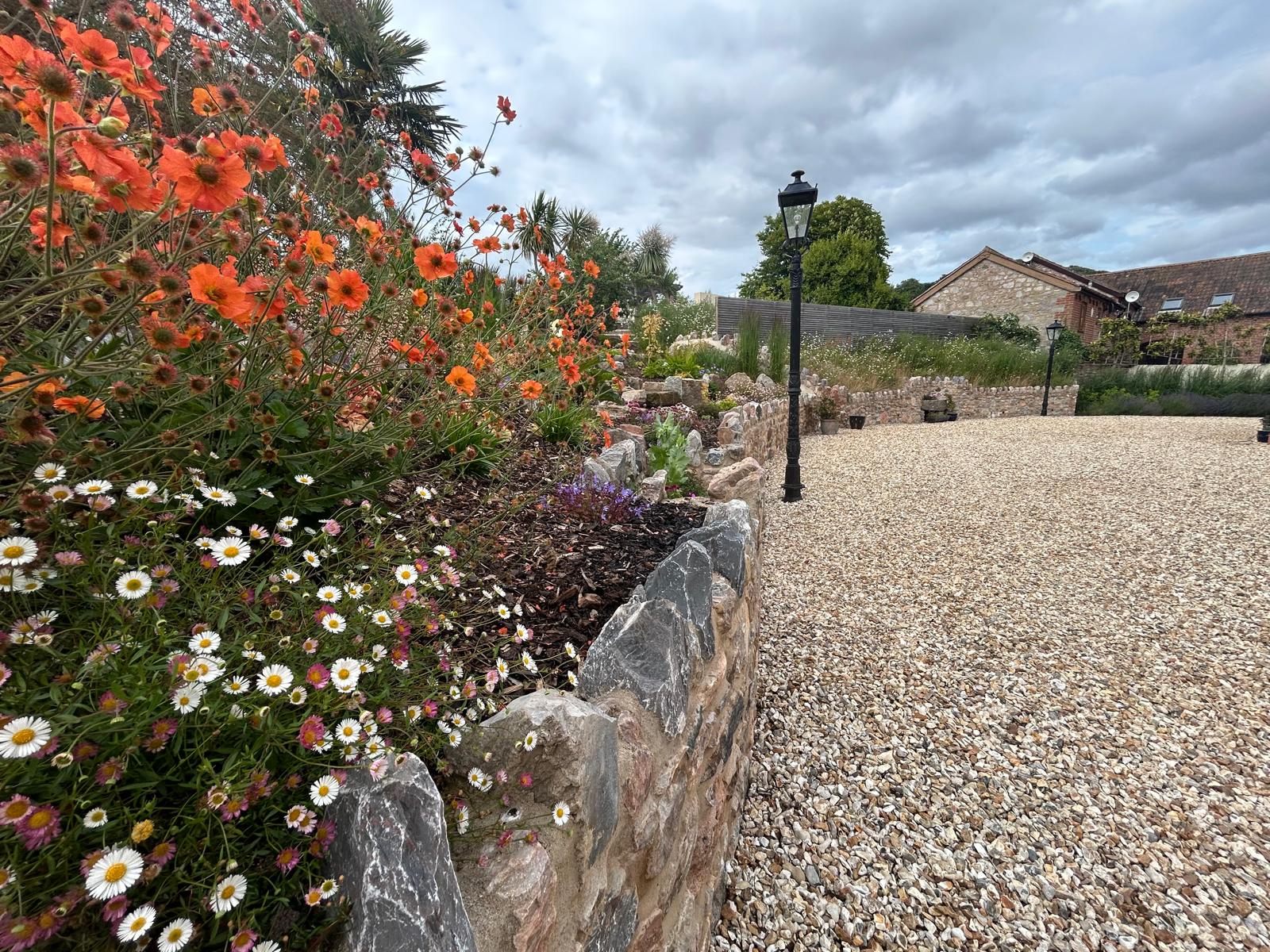
Walkway surrounded by wild flowers.

If you have any tender plants or are growing vegetables in your garden, you may want to consider a horticultural fleece that offers greater insulation. If you notice plants that are looking a bit flimsy or worse for wear, support them with wooden stakes to ensure any strong winds do not destroy them.

Finally, if you have potted plants outdoors that might not be able to handle the frost, consider bringing them indoors or storing them in garden shelters during particularly cold nights.

De-Weed The Garden

As every gardener will know, weeds can be extremely problematic if left unattended. The best way to stop weeds running wild in your garden over winter is to tackle them before the season arrives. 

Take some time to thoroughly de-weed your garden before winter, so that by the time spring rolls around once again, it is not a big problem.

Ensure you’re removing weeds directly from the root to stop them from simply growing back again. You can also use weed killer if you find it easier than pulling them out by hand.  

Maintain Driveways and Patios

It’s not just your gardens that require some TLC during the winter months.

In fact, you should pay attention to all of your home’s outdoor areas. 

This includes driveways and patios that can become icy, slippy and potentially dangerous during the winter. 

Gravel driveway.

With this in mind, we’d recommend pressure washing these areas as part of your winter preparation. This is because it’ll remove any stains or marks that could become even slippier with the addition of ice. 

You could also use de-icer on surfaces to try and prevent ice from forming. 

Decommissioning Irrigation Systems

Some gardens, particularly commercial gardens, may feature large-scale irrigation systems that keep lawns and plants well-watered and ensure they have the appropriate amount of water. 

During winter it is recommended that these systems are decommissioned. This can be done simply by switching off the garden tap or, for more complex systems, you may need a dedicated shut-off valve.  

Prepare Garden Water Features

It’s best to drain any water features you have in your garden during the winter months. This is because the water can freeze in the ornaments, causing the structure to crack or cause other damage. 

Pond in front of a stone water feature.

With this in mind, we recommend draining the water from these features as it gets colder as well as switching off any pumps that are being used. Water fountains and birdbaths are the most common types of water features in your garden that will likely need to be looked after.  

If you’re based in Exeter, Tiverton, Newton Abbott or the surrounding areas, Atlantes Landscapes is here to help you keep your garden in the very best condition in winter and all year round. We offer leading garden maintenance services that include garden lighting maintenance, lawn care, hedge trimming and much more. To find out more about the garden servicing options we can provide, get in touch with our team today. 

Top Tips For Narrow Gardens

Narrow gardens present a great challenge to design and build and this can be overcome by some imaginative ideas such as

  • Introduction of curves
  • Changes in levels
  • Water features
  • Planting

Firstly when planning any garden you need to carry out a thorough detailed survey and take photos to remind yourself of any aspects of the original garden

Narrow Gardens Atlantes Landscapes

Then begin the design process starting from the inside (the heart of the garden) and work outwards. Do not design a garden around the boundaries or you will only reflect the boundary lines in your concept ideas, keep playing with curves, lines and junctions until you are happy with the flow.

When designing the garden be mindful of the client brief, this is about the most important part as not listening to the client will result in a design that they will never be satisfied with and subsequently you are unlikely to be successful in sealing the contract for the build.

Small narrow gardens are great fun to work with as you can achieve so much and introduce many features and aspects to create an interesting garden.

Narrow gardens for Atlantes Landscapes

From the above pictures you can see how the curved path takes your eye away from the straight boundary lines and leads you down the garden. Once the shrubs, that are located in strategic positions fully develop the aspect will once again change and give the impression of ‘what’s down the path and around the corner’.

Here we have many features that the client wished for such as 

  • Raised shrub borders
  • Water feature
  • No lawn
  • Substantial terrace for entertaining
  • White, blue and pink planting
  • New fencing
  • Aggregate pathway (8mm – 10mm Scottish pebbles)
  • Textured paving (Indian Sandstone)

This garden was designed by Paul Bentley MBALI MSGD and constructed by us

Narrow Gardens Atlantes Landscapes

Atlantes Landscapes are family run landscape gardeners covering Devon, Exeter, Tiverton & Newton Abbot. Contact us today for more information.